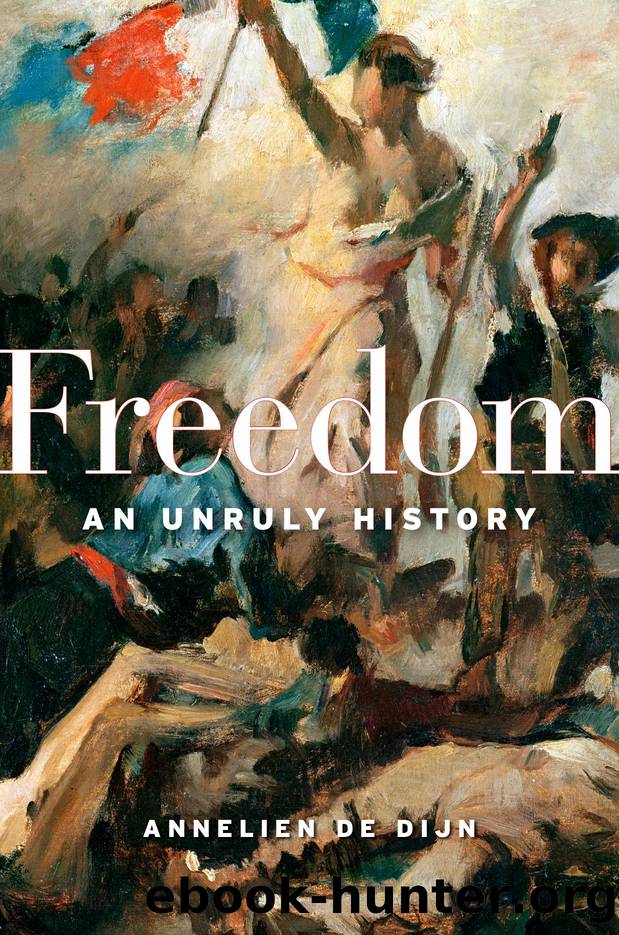
Freedom by Annelien de Dijn
Author:Annelien de Dijn
Language: eng
Format: epub
Publisher: Harvard University Press
PART III
Rethinking Freedom
CHAPTER 5
Inventing Modern Liberty
IN 1784, Johann August Eberhard published the essay On the Liberty of the Citizen and the Principles of the Form of Government. A philosophy professor at the University of Halle, Eberhard was mainly known for his enlightened religious views. He had caused a minor scandal in 1772 by arguing that salvation did not depend on revelation and that, hence, a heathen could go to heaven. But, as his 1784 essay showed, Eberhard also had a keen interest in moral and political questions. The essay, he explained, was a contribution to the ongoing debate about what it meant to be free in a society or as a society. He wanted to correct the âyoung republicansâ who believed that freedom was to be found only in democracies and not in monarchies. While Eberhard did not specify who these young republicans were, it seems plausible that at least some of them had been inspired by the example of the American Revolution.1
Indeed, since the outbreak of the War of Independence, the American fight for freedom had generated considerable enthusiasm, and the struggle between Great Britain and its recalcitrant colonies was extensively reported in the German-language press. In 1783, the widely read journal Berlinische Monatsschrift celebrated American victory against the English with the poem âAmericaâs Liberty.â But some Germans went further, not just celebrating American victory against the British, but also arguing that Europeans should likewise try to liberate themselves by getting rid of royal absolutism. In 1782 Johann Christian Schmohl, a resident of Halleâand, like Eberhard, a subject of the Prussian king Frederick the Greatâpublished On North America and Democracy, in which he praised the Americans for their fight for âpopular sovereigntyâ and expressed the hope that Europe too would soon throw off the yoke of âtyrannyâ and thus gain âliberty.â2
Eberhard strongly disagreed with such views. It was an âunfounded prejudice,â he wrote, to believe that liberty was to be found only in democratic republics. The subjects of Frederick the Great already were freeâhence, they needed no liberatingâbut they were free in a different way from the citizens of popular republics. To clarify, Eberhard explained that, when talking about âthe liberty of the citizen,â one should distinguish between two very different kinds of liberty: civil liberty and political liberty. A people had political liberty when it participated in government. Hence political liberty existed only in republics, and it was most extensive in democratic republics. In contrast, individuals who had the right to act as they wished, insofar as such acts were not restricted by law, enjoyed civil liberty. This type of liberty did not depend on the form of government; it could exist as easily in a monarchy as in a republic.
Eberhardâs distinction between civil and political liberty was quite novel. As we have seen, some thinkers in the seventeenth century had begun to distinguish between natural liberty (the liberty one enjoyed in the state of nature) and civil liberty (the liberty one could enjoy in society).3 Throughout the
Download
This site does not store any files on its server. We only index and link to content provided by other sites. Please contact the content providers to delete copyright contents if any and email us, we'll remove relevant links or contents immediately.
| Anthropology | Archaeology |
| Philosophy | Politics & Government |
| Social Sciences | Sociology |
| Women's Studies |
The Secret History by Donna Tartt(19443)
The Social Justice Warrior Handbook by Lisa De Pasquale(12286)
Thirteen Reasons Why by Jay Asher(9106)
This Is How You Lose Her by Junot Diaz(7044)
Weapons of Math Destruction by Cathy O'Neil(6455)
Zero to One by Peter Thiel(5930)
Beartown by Fredrik Backman(5915)
The Myth of the Strong Leader by Archie Brown(5619)
The Fire Next Time by James Baldwin(5573)
How Democracies Die by Steven Levitsky & Daniel Ziblatt(5318)
Promise Me, Dad by Joe Biden(5225)
Stone's Rules by Roger Stone(5181)
A Higher Loyalty: Truth, Lies, and Leadership by James Comey(5075)
100 Deadly Skills by Clint Emerson(5016)
Rise and Kill First by Ronen Bergman(4886)
Secrecy World by Jake Bernstein(4861)
The David Icke Guide to the Global Conspiracy (and how to end it) by David Icke(4837)
The Doomsday Machine by Daniel Ellsberg(4608)
The Farm by Tom Rob Smith(4591)
